
Clean Agent Fire Suppression Systems
Explore Jianan’s fire suppression product development support, including requirement review, product engineering, prototypes, verification, production preparation, and OEM manufacturing.
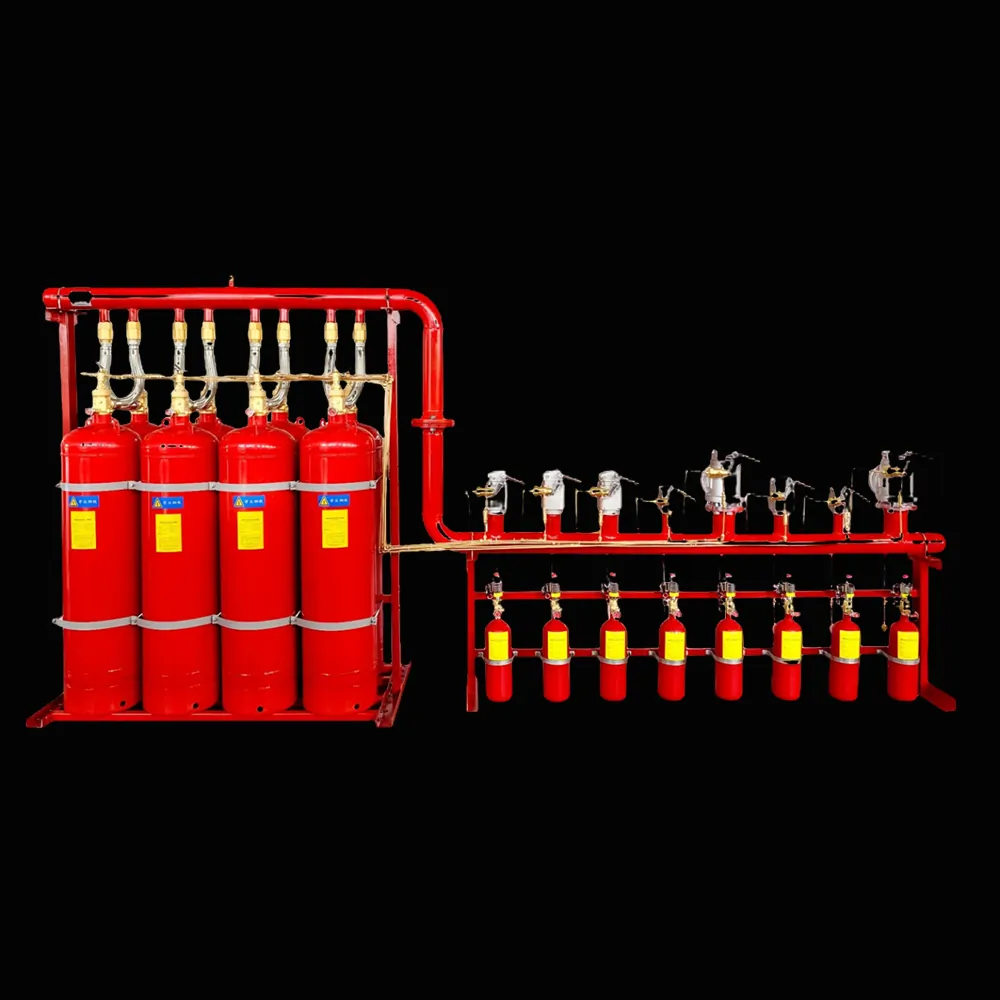
Clean Agent Fire Suppression Systems for Critical Enclosures
Jianan Fire Protection Technology supplies clean agent fire suppression systems for enclosed hazards where water or residue could damage equipment and disrupt operations.
Available systems include HFC-227ea, FK-5-1-12, IG-100, and IG-541. Halocarbon agents offer a compact cylinder footprint, while inert gas systems require high-pressure storage and larger cylinder banks.
Designed mainly for total-flooding applications, these systems can include cylinders, valves, manifolds, piping, nozzles, detection and release controls, alarms, manual release stations, and accessories.
Our engineering team assesses hazard conditions, enclosure characteristics, cylinder placement, pipe routing, and project requirements to recommend the most suitable system configuration.
Clean Agent Fire Suppression Systems

HFC-227ea Systems
Halocarbon systems offering relatively compact agent storage for electronic, electrical, telecommunications, control, and other enclosed equipment hazards.
HFC-227ea remains used in fire-suppression applications, but project selection should consider the U.S. HFC phasedown, long-term agent availability, refill strategy, environmental policy, and local servicing capability.

IG-100 Fire Suppression Systems
Inert-gas systems using compressed nitrogen to reduce the oxygen concentration within a protected enclosure to a level that suppresses combustion.
IG-100 systems require engineered high-pressure cylinder storage, piping, nozzle distribution, enclosure-integrity review, and pressure-relief evaluation.

FK-5-1-12 Fire Suppression Systems
Fluorinated-ketone systems intended for projects requiring electrically nonconductive, residue-free suppression with a relatively compact storage footprint.
The actual agent manufacturer, filling documentation, hardware compatibility, refill source, and future servicing pathway should be confirmed for each project. FK-5-1-12 is a generic agent designation and should not automatically be treated as a specific commercial brand.

IG-541 Fire Suppression Systems
Inert-gas systems using a blend of nitrogen, argon, and carbon dioxide for engineered total-flooding protection.
Selection should consider cylinder-bank space, pipe routing, oxygen concentration, occupant exposure, enclosure pressure, venting, agent-retention time, and local high-pressure cylinder service.
Clean Agent Comparison
| Agent | Key Details |
| HFC-227ea | Family: Halocarbon |
| Storage: Liquefied agent in superpressurized cylinders | |
| Cylinder footprint: Generally compact | |
| Characteristics: Rapid discharge, electrically nonconductive, no extinguishing residue | |
| Project considerations: HFC phasedown regulations, agent availability, refill strategy, design concentration, exposure limits, and project acceptance requirements | |
| FK-5-1-12 | Family: Fluorinated ketone |
| Storage: Liquefied agent in superpressurized cylinders | |
| Cylinder footprint: Generally compact | |
| Characteristics: Rapid discharge, electrically nonconductive, no extinguishing residue, and lower global-warming potential than HFC agents | |
| Project considerations: Agent source, hardware compatibility, refill availability, design concentration, exposure limits, and project acceptance requirements | |
| IG-100 | Family: Inert gas |
| Storage: High-pressure compressed nitrogen | |
| Cylinder footprint: Generally requires more cylinder space | |
| Characteristics: Extinguishes fire primarily by reducing oxygen concentration and leaves no residue | |
| Project considerations: Cylinder-bank location, oxygen concentration, occupant exposure, hydraulic calculations, discharge pressure, venting, and retention time | |
| IG-541 | Family: Inert gas blend |
| Storage: High-pressure compressed nitrogen, argon, and carbon dioxide | |
| Cylinder footprint: Generally requires more cylinder space | |
| Characteristics: Extinguishes fire primarily by reducing oxygen concentration and leaves no residue | |
| Project considerations: Cylinder arrangement, oxygen concentration, occupant exposure, pipe network design, discharge pressure, venting, and retention time |
This comparison is intended for preliminary system selection. Cylinder quantity, storage pressure, agent concentration, discharge time, pipe limitations, nozzle arrangement, pressure-relief area, and retention requirements depend on the selected system and project design.
Halocarbon systems are often selected where equipment-space limitations favor a smaller cylinder footprint. Inert-gas systems may be preferred where zero-ozone-depletion and very low or zero direct global-warming impact are important, provided sufficient cylinder space and high-pressure piping capacity are available.
System Configurations
Engineered Pipe Network Systems
One or more cylinders discharge through a fixed piping and nozzle network designed for the actual enclosure.
Engineered systems are commonly used for larger rooms, irregular spaces, multiple-nozzle arrangements, concealed voids, or projects where cylinders must be installed outside the protected enclosure.
Final pipe diameters, equivalent lengths, nozzle orifices, flow distribution, and discharge performance must be established through the applicable system calculation method and design documentation.
Pre-Engineered and Modular Systems
A cylinder, valve, actuation device, and discharge assembly are configured as a compact or self-contained unit for a defined hazard or enclosure.
These systems may simplify installation for smaller equipment rooms, cabinets, machinery enclosures, or other limited-volume hazards. Selection remains subject to the model’s approved volume, agent fill, nozzle arrangement, pipe limitations, temperature range, and installation instructions.
A cabinet-mounted enclosure is a construction format and does not by itself establish that a system is pre-engineered.
Multi-Cylinder and Reserve Systems
Multiple cylinders may be connected through a manifold to provide the required agent quantity for larger enclosures.
A separate reserve bank may be specified for hazards where protection must be restored rapidly after a discharge or where uninterrupted suppression capability is required. Cylinder size, fill quantity, valve, hose, manifold, actuation, and supervisory components must be compatible within the selected system.
Multi-Zone Systems
Where supported by the selected system architecture, a shared cylinder bank may protect more than one hazard through selector valves.
Multi-zone arrangements require coordinated detection zoning, selector-valve sequencing, releasing logic, reserve-capacity review, flow calculation, and confirmation that the proposed configuration falls within the system’s documented design limits.
Detection and Releasing Configuration
Clean agent release may be initiated by automatic detection, manual activation, or an agreed combination of both.
Depending on the project, the release sequence may include:
- Cross-zoned or multi-criteria detection
- Pre-discharge audible and visual alarms
- Time-delayed discharge
- Manual release stations
- Abort controls where permitted
- HVAC shutdown
- Damper or door closure
- Equipment or fuel shutdown
- Pressure-relief vent operation
- Supervisory and alarm-system interfaces
The final sequence must be coordinated with the releasing control panel, system design documents, occupancy requirements, and local fire-protection strategy.
Applications
Clean agent fire suppression systems protect enclosed areas where equipment must be protected and cleanup kept to a minimum.
Common applications include data centers, server rooms, telecommunications rooms, electrical rooms, control rooms, equipment enclosures, archives, museums, and medical equipment rooms.
These systems are commonly used for Class A surface fires, Class B flammable liquids, and energized electrical equipment. They are generally not suitable for reactive metals, self-oxidizing materials, deep-seated fires, or hazards with a continuous fuel supply unless the fuel can be isolated.
Lithium-ion battery risks require separate evaluation. Clean agents may suppress surrounding fires but should not be expected to stop thermal runaway or prevent reignition.
Enclosure and Pressure Requirements
The protected enclosure must hold the required agent concentration for the specified time. Openings, ducts, and ventilation systems can reduce retention, so sealing and HVAC shutdown may be required.
Agent discharge can also increase enclosure pressure. Pressure-relief venting is often required, especially for inert gas systems.
Discuss Your Product Development Project
Frequently Asked Questions
Find quick answers about product selection, installation, compliance, and customization.
What is the difference between halocarbon and inert-gas clean agent systems?
Halocarbon systems (HFC-227ea, FK-5-1-12) use liquefied agents and usually need less cylinder space. Inert-gas systems (IG-100, IG-541) use compressed gases and typically require larger cylinder banks.
Which clean agent should I select for my project?
Selection depends on factors such as hazard type, room size, occupancy, available space, environmental requirements, and local service support. It should not be based only on room type or initial cost.
What information is required for system selection and quotation?
Choose the cabinet by the extinguisher’s actual dimensions, not capacity alone. Common cabinet categories include 5 lb, 10 lb, and 20 lb extinguishers, but fit should be confirmed by overall height, cylinder diameter, hose position, valve layout, handle clearance, and cabinet inside dimensions. Capacity labels should not be treated as universal compatibility.
Does a clean agent room require an enclosure-integrity test or pressure-relief vent?
Provide room dimensions, protected hazards, occupancy, temperatures, ventilation conditions, cylinder location, and available drawings. Any special hazards should also be identified.
What can Jianan supply for a clean agent project?
Jianan can supply clean agent cylinders, valves, manifolds, nozzles, detection devices, control panels, alarm devices, and related hardware. Technical support may include equipment selection, calculations, layout coordination, and documentation.